
Pricing Strategy for a Central Florida Light-Fleet On‑Road
Driver Coaching Service
Assumptions
Service area: Central Florida, Orlando
Banding Where multiple lessons for several drivers are scheduled on the same day
The “Standard Ride-Along” is 1-2 Hours of On-Road Seat Time.
Anything not supported by a primary/credible source is marked “unspecified.”
Fleet Safety Programs
Fleet driving lessons are to be conducted either at the company location or on roads in the local vicinity.
Pinnacle Fleet Safety Training
Reduce Risk. Improve Driver Performance. Protect Your Business.
Fleet Safety Snapshot (Entry Assessment)
A focused evaluation designed to identify immediate risk exposure and improvement opportunities.
Ride-along driver assessments
Baseline risk analysis
Executive summary + 90-day action plan
Credit applied toward ongoing programs
Driver Performance Training
From $150 per driver
Targeted, behind-the-wheel coaching in real-world conditions.
- Route-based evaluation
- Risk behavior correction
- Performance documentation
- Fleet Training Programs
Custom structured packages available
Built for companies operating 5–50 vehicles seeking consistent driver standards.
- Multi-driver training blocks
- Standardized reporting
- Priority scheduling
- Ongoing Risk Reduction Program (Recommended)
Starting at $1,500/month
For companies serious about reducing incidents and liability exposure.
- Continuous driver evaluations
- Risk trend tracking
- Monthly performance reporting
- Strategic safety planning
- The Cost of Inaction
A single preventable incident can cost $8,000 – $78,000+
in repairs, downtime, insurance increases, and liability.
Professional training costs a fraction of that.
Next Step

Terms & Conditions
- All lesson invoices are payable in advance or within 15 days of the invoice date.
- Any cancellation of lesson/s before 48 hours is required to be notified in writing to Rak Sharma, Owner/Operator. Failure to do so can cause the scheduled lesson to be due and payable.
- Late payments beyond the due invoice date can result in a 'late payment' charge of 2.5% of the total invoice amount due.
- The only exceptions are if the weather is inclement, which may cause dangerous driving conditions for the company driver/s and the Pinnacle Instructor.
Executive summary
Local benchmark prices for behind‑the‑wheel lessons in Central Florida cluster around ~$75–$92 per hour of instruction (consumer market), based on publicly posted lesson-package pricing from Florida Safety Council[5] ($165 for 2 hours), South Lake Driving School[6] ($299 for 4 hours), and Atlantic Driving School[7] ($549 for 6 hours). [8]
To be both affordable and clearly differentiated, the recommended strategy is a hybrid productized model that (a) offers a compelling per-driver / per-incident “ride-along + documentation” unit, and (b) introduces a subscription retainer (6–20 and 21–50 vehicle segments) that competitors typically do not package for light fleets. This model keeps entry friction low while making recurring revenue possible and defensible through standardized reporting (driver scorecards, manager debriefs, KPIs). [9]
Differentiation is created by bundling deliverables that local consumer driving schools generally do not advertise as a B2B product: same‑vehicle coaching (work van/truck), post‑incident remediation workflows, written “return‑to‑drive” documentation, monthly fleet KPI reporting, optional telematics alignment, and contract-based service levels. Telematics market pricing (e.g., Azuga[10] at $25/vehicle/month basic tracking and SafetyCam starting at $49.99/month) offers a reference point: your service should be positioned as the human coaching layer that makes telematics and policies actually change behavior—without forcing small fleets to buy an enterprise stack first. [11]
Benchmark pricing signals and what buyers compare you against
Small fleets typically compare your pricing to three “substitute budget buckets,” each with very different price anchors:
Behind-the-wheel lesson providers (local, consumer-priced):
- Florida Safety Council[5] lists behind-the-wheel lessons at $165 for a 2-hour lesson (vehicle + insurance included). [12]
- South Lake Driving School[6] lists a $299 4-hour training package. [13]
- Atlantic Driving School[7] lists a 6-hour program at $549. [14]
A realistic implication: if you price a 2-hour ride-along at $225–$325, you are not competing on “cheap driving lessons.” You are competing on: (1) business documentation, (2) work-vehicle specificity, (3) incident reduction, and (4) manager-facing reporting.
Scheduling efficiency: subscription and pack discounts assume batched delivery (multiple drivers coached on the same visit/day to minimize travel and admin time).
Online defensive driving / compliance training (low-cost, scalable):
- National Safety Council[15] sells an online defensive driving course product with listed pricing (example: $54.10 list price for a defensive driving online product, with volume pricing tiers visible). [16]
- SafetyServe[17] lists Florida BDI/driver-improvement course options at $29.95 for a 4-hour BDI course (example listing). [18]
A realistic implication: Buyers can always say “we’ll just put them through an online course.” Your pricing must therefore emphasize measurable behavior change and targeted remediation (high-risk drivers, new hires, post-incident drivers) rather than “training everyone equally.”
ROI framework: crash costs vary widely; the model emphasizes customer-specific ROI tracking and uses national crash-cost context for framing only (see KPI section). ⦁ [4]
Fleet safety programs (corporate classes and telematics):
- Nations Traffic Safety School[19] markets corporate driver safety programs with “solutions starting at $25 per employee.” [20]
- Tampa Bay Training[21] runs onsite defensive driving training for groups with minimum participant requirements and travel fee policies. [22]
- Azuga[10] publishes GPS tracking pricing at $25 per vehicle per month and notes SafetyCam “starting at $49.99/month.” [23]
- Autosist[24] publishes fleet software pricing (example: $6 per vehicle/month billed annually or $7 monthly; minimum $59/month for 5 vehicles). [25]
- Geotab[26] notes fleet GPS tracking system costs can vary widely (example range references like $15–$50/vehicle/month across providers in a cost breakdown discussion). [27]
A realistic implication: telematics often costs tens of dollars per vehicle per month before hardware/camera costs; your service can be positioned as behavior change + coaching + documentation that is deployable even for fleets too small to operationalize a full safety stack immediately. [28]
Productized pricing model designed for affordability and differentiation
Target customer segments and buying triggers
Segment 1–5 vehicles
Owner-led home services and micro NEMT providers
Common triggers
1–2 incidents, new-hire who “can drive” but can’t handle routes/backing, insurer pressure, or a single high-risk driver.
Segment 6–20 vehicles
growing trades/NEMT fleets with informal safety management
Common triggers
recurring backing/parking claims, near-miss complaints, new drivers cycling in, and “we need something that actually changes habits.”
Segment 21–50 vehicles
established local operators with a safety champion but limited bandwidth
Common triggers
Rising insurance premiums/renewals, repeated claims frequency, or a new fleet safety initiative without internal trainers.
Core service units and deliverables
Standard Ride‑Along Evaluation (productized unit)
- Session length: 2 hours on-road seat time (in client vehicle when possible).
- Deliverables (within 24–48 hours):
- Driver scorecard (scanning, following distance, intersections, lane changes, backing/parking, distraction control, speed management).
- “Top 5 coaching priorities” with specific behaviors to fix
- Manager email summary + recommended next step (follow-up ride vs. cleared).
- Differentiator: documents work-relevant behaviors instead of “how to pass the road test.”
Post‑Incident Remedial Package (productized unit)
- Inputs: brief incident intake (what happened, when, where; any video/telematics if available).
- Session: 2-hour ride-along focused on the specific failure modes.
- Deliverables: “return-to-drive” remediation memo + retraining plan (for HR/insurance file).
- Differentiator: converts an accident into a structured remediation workflow.
Follow‑Up Check Ride (productized unit)
- 1-hour seat time to validate improvement and close the loop for the manager.
Buyer journey and pricing decision points
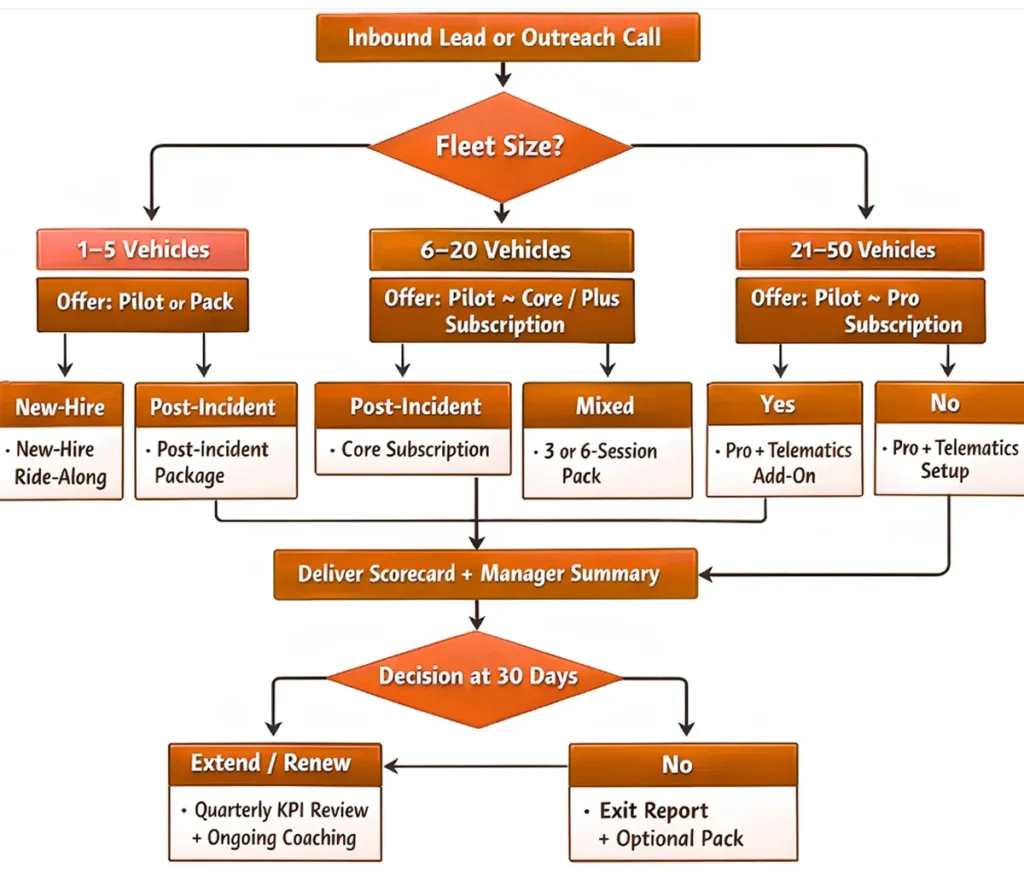
Proposed packages and price points
The model below is intentionally positioned slightly above consumer lesson pricing to reflect business deliverables, but it stays materially below “enterprise consulting” by keeping packages tight and repeatable. Benchmarks for the local consumer market are shown earlier. whether your fleet is actively reducing preventable risk.
Pilot / intro offer (all segments)
Fleet Safety Snapshot (Pilot)
- Includes: intake call + up to 2 ride-along evaluations (2h each) + baseline KPI dashboard + 90‑day action plan.
- Price: $650 flat (credited $250 toward a subscription or pack if purchased within 30 days).
- Rationale: creates a measurable baseline and a low-risk entry point; anchors the “business value” correctly.

Table 1: Pricing tiers comparison
| Segment | Package | Pricing unit | Price | What’s included (productized deliverables) | Best for |
|---|---|---|---|---|---|
| 1–5 vehicles | Pay‑as‑you‑go New‑Hire Ride‑Along | per driver/session | $275 | 2h ride-along + scorecard + manager summary email + “coach-to-standard” checklist | New hires, occasional needs |
| 1–5 vehicles | Pay‑as‑you‑go Post‑Incident Remedial | per driver/package | $395 | Incident intake + 2h ride-along + remediation memo + manager debrief | After an accident/complaint |
| 1–5 vehicles | 3‑Session Pack | per pack | $735 | Any 3 standard ride-alongs; shared fleet KPI tracker; scheduling priority | Micro-fleets that want commitment without monthly billing |
| 1–5 vehicles | 6‑Session Pack | per pack | $1,380 | Any 6 standard ride-alongs; quarterly KPI summary; scheduling priority | Fleets that hire frequently or have recurring issues |
| 6–20 vehicles | Core Subscription | per month (6‑mo min) | $1,195 | 4 standard ride‑alongs/month (batched) + monthly KPI report + 30‑min safety huddle call | Stable fleets with periodic onboarding & coaching |
| 6–20 vehicles | plus Subscription | per month (12‑mo min) | $1,795 | 6 ride‑alongs/month + monthly KPI + manager SOP refresh + priority scheduling | Fleets with repeat claims and higher churn |
| 21–50 vehicles | pro Subscription | per month (12‑mo min) | $2,695 | 8 ride‑alongs/month + monthly KPI + quarterly “risk review” session + optional telematics alignment | High-utilization fleets needing consistent safety operations |
| Any | Follow‑Up Check Ride | per driver/session | $175 | 1h verification ride + before/after scoring | Closing the loop after coaching |
Unit economics and margin model
Cost structure (what drives your costs)
The biggest cost driver is instructor time. To keep discounted packages profitable, you need batching rules (multiple drivers in one location/day) to reduce travel/admin time per driver.
Key variable cost inputs used in the example unit economics model below: – Instructor “fully loaded” cost (labor + overhead allocation): $45/hour (assumption; adjust to your reality). – Average business travel allocation (batched): ~15–20 miles per delivered session; cost proxy uses the 2026 IRS business mileage rate 72.5¢/mile. [3] – Materials/admin: minimal per session (assumption).
Unit economics / margin table
Table 2: Unit economics / margin (example model; adjust inputs to your business)
| Offering | Pricing unit | Price | Estimated direct cost | Gross margin |
|---|---|---|---|---|
| Standard ride‑along (2h seat time) | per driver/session | $275 | $172 | 37.3% |
| Post‑incident remedial (2h + incident review) | per driver/package | $395 | $195 | 50.6% |
| Follow‑up check ride (1h seat time) | per driver/session | $175 | $100 | 42.6% |
| 3‑session pack | per pack | $735 | $473 | 35.7% |
| 6‑session pack | per pack | $1,380 | $946 | 31.5% |
| Core subscription (6–20 vehicles) | per month | $1,195 | $720 | 39.7% |
| Plus subscription (6–20 vehicles) | per month | $1,795 | $1,058 | 41.0% |
| Pro subscription (21–50 vehicles) | per month | $2,695 | $1,478 | 45.1% |
Notes on the model: discounted packs/subscriptions assume batched scheduling. If a client insists on “one driver at a time, scattered sites,” either (a) add travel/time premiums, or (b) restrict discounted pricing to batched delivery.
KPIs and reporting to justify ROI
This category is where you most clearly differentiate from consumer driving schools and low-cost online courses: you sell a measurable safety management process.
Why buyers care (credible framing)
Bureau of Labor Statistics [29] reports transportation incidents remain the most frequent type of fatal occupational event, accounting for 38.2% of all occupational fatalities in 2024. ⦁ [30]
National Highway Traffic Safety Administration [31] estimates traffic crashes imposed $340B in economic costs in 2019, with “societal harm” estimates approaching $1.4T when quality-of-life valuations are included (national context). [4]
KPI set that a small fleet can actually track
Minimum viable KPI pack (no telematics required): – Incidents per month (all crashes + near-miss/complaints tracked internally). – Backing/parking incidents count. – Citations count. – “Red behaviors” observed in ride-alongs (e.g., rolling stops, following distance, phone handling, unsafe backing). – New-hire time-to-safe-independence (days from hire to “cleared” ride check).
If telematics is available (optional): – Harsh braking/acceleration events per 1,000 miles. – Speeding events. – Seatbelt events and phone-distraction events (camera-based; vendor dependent). – Coaching completion rate.
Telematics alignment add-on should be vendor-agnostic; for example, Azuga[10] explicitly bundles driver scoring/rewards with $25/vehicle/month tracking plans and offers camera starting prices. [23]
Reporting deliverables you should productize (to defend renewal)
- Driver Scorecard (per session): 0–5 scoring per category + notes + “next actions.”
- Manager Summary (per driver): “Clear / needs follow-up / not cleared” decision and why.
- Monthly Fleet Safety KPI Brief (subscription): 1–2 pages max: trends, repeat patterns, top risks, top wins.
- Quarterly Executive Summary (Pro): what improved, what didn’t, what to do next quarter.
Pilot offers, volume discounts, and contract terms
Use the “Fleet Safety Snapshot” pilot to quickly convert skepticism into a plan with measurable baseline data. It also creates a clean decision point: do nothing vs. subscribe.
Suggested pilot guarantee (affordable and strong):
“If we fail to identify at least 5 actionable coaching improvements across the ride-alongs, we credit 100% of the pilot fee toward your next month or pack.” (Guarantee structure is internal; no external benchmarking found → unspecified.
Volume discounts that won’t destroy margin
Use two levers: – Lower per-session pricing only when sessions are batched. – Discount more for longer terms (e.g., 12-month Pro vs 6-month Core)
Suggested discount rules (simple to explain): – Packs/subscriptions require minimum 2 sessions per onsite visit or a batching schedule. – Additional sessions beyond plan: discounted rate only if added to an already scheduled “route coaching day.”
Contract terms (recommended defaults)
Minimum term: packs expire (e.g., 6 sessions valid 12 months); subscriptions: Core/Plus 6-month minimum; Pro 12-month minimum (all assumptions).
Cancellation/reschedule: 48-hour notice for no fee; <48 hours: 50% fee; same-day: 100% fee (adjust as you learn).
Weather: reschedule without penalty for severe weather (especially relevant for on-road sessions; unspecified).
Indemnification/insurance: require confirmation that the driver coaching will be conducted under allowable conditions and with proper commercial coverage; consult counsel/insurance broker for exact language (unspecified).
Sales packaging, add-ons, objections, and closing scripts
Bundles and add-ons (differentiators competitors seldom productize)
Teamed Onboarding Bundle (for trades): ride-along + “first 30 days driving SOP” + follow-up check ride for one price (upsell from $275 to a $425 bundle; internal model
Post‑Incident Documentation Add‑On: expanded written remediation memo formatted for HR/insurance file; included in $395 package above.
Telematics Alignment Add‑On: setup + monthly review + event-to-coaching workflow:
Setup (one-time): $350
This matches the reality that telematics itself can be $25/vehicle/month (basic) or more (camera), and your value is converting data into behavior change. ⦁ [32]
Common objections and rebuttals
Objection: “We can just do an online defensive driving course.”
Rebuttal: “Absolutely—online training is great for baseline knowledge. Our ride-alongs are for behavior change in your exact work vehicles, routes, and job pressure, with a written manager scorecard and a close-the-loop follow-up. Think of us as the field-coaching layer that online training can’t provide.” (Benchmark: online course seat pricing and volume pricing exists, but it’s not vehicle-specific coaching.) [16]
Objection: “We already bought GPS tracking.”
Rebuttal: “Perfect—GPS and cameras tell you what happened. We turn those events into a coaching plan and document improvement, so you can show action taken at renewal time.” (Telematics pricing and data orientation are widely vendor-positioned.) [32]
Objection: “This seems expensive compared to driving lessons.”
Rebuttal: “Driving lessons are priced for individuals and test prep. We’re a B2B safety service: ride-alongs + documentation + manager reporting + repeatable KPIs. We price it so one prevented minor incident typically pays for months of coaching—while also improving retention and professionalism.” (Use your client’s own incident costs as the proof; national crash cost context supports seriousness.) [4]
Objection: “We don’t have time to pull drivers off routes.”
Rebuttal: “That’s why sessions are 2 hours with batching. We schedule early mornings, mid-day slow windows, or ride along during normal service calls—so it’s coaching inside work, not ‘training day’ disruption.” (Operational model; unspecified.)
Sample sales scripts
Phone opener (30–45 seconds):
“Hi [Name], this is [Your Name]. I work with small service fleets here in Central Florida—HVAC, plumbing, electrical, medical transport—to reduce preventable vehicle incidents.
Quick question: if you had to guess, what’s been your #1 driving-related headache this year—backing accidents, new-hire risk, speeding, complaints, or insurance renewal pressure?
The reason I’m calling is we run a 2-hour ride-along in your actual work vehicle and deliver a manager scorecard within 24–48 hours. It’s very practical—focused on the behaviors that cause claims. Would it be crazy to set up a $650 ‘Fleet Safety Snapshot’ for two drivers next week so you can see the baseline?”
Follow-up email (short, copy/paste): Subject: “2-hour ride-along + manager scorecard (preventable incident reduction)”
Hi [Name] —
As promised, here’s how we help small fleets (1–50 vehicles) reduce preventable incidents:
- 2-hour ride-along coaching in your work vehicle
- Driver scorecard + top 5 fixes
- Manager summary + next step (clear / follow-up / remediation)
Pilot option: Fleet Safety Snapshot ($650) — 2 drivers + baseline KPI plan.
If helpful, send me 2 time windows next week and the vehicle type(s) (Transit, Sprinter, box truck, wheelchair van, etc.).
— [Signature]
Close (when buyer hesitates on subscription):
“Let’s do it in two steps. First, the Snapshot gives you a baseline and tells us which drivers and behaviors are creating the risk. If you like it, we roll the credit into a 6‑month Core plan—four ride-alongs a month, batched, with a monthly KPI report—so you can show progress and reduce repeats.”
Twelve-month revenue projection model for a small operator
This is a simple capacity-aware model where pay‑as‑you‑go sessions are the “overflow” after subscription sessions are delivered. It assumes an average pay‑as‑you‑go realized price of ~$310 per session (mix of $275 new-hire and $395 post-incident). (Assumption; adjust.)
Table 3: 12‑month revenue scenario table (Apr 2026–Mar 2027)
| Month | Conservative | Likely | Optimistic |
|---|---|---|---|
| Apr 2026 | $4,370 | $5,610 | $6,850 |
| May 2026 | $3,720 | $4,960 | $6,200 |
| Jun 2026 | $3,720 | $6,155 | $7,395 |
| Jul 2026 | $4,295 | $6,155 | $7,395 |
| Aug 2026 | $4,295 | $6,155 | $9,970 |
| Sep 2026 | $4,295 | $6,155 | $9,620 |
| Oct 2026 | $3,675 | $7,350 | $10,860 |
| Nov 2026 | $3,675 | $7,350 | $10,860 |
| Dec 2026 | $3,675 | $7,350 | $12,675 |
| Jan 2027 | $3,675 | $7,350 | $12,675 |
| Feb 2027 | $3,675 | $7,350 | $12,675 |
| Mar 2027 | $3,675 | $7,350 | $12,675 |
| 12‑mo total | $46,745 | $79,290 | $119,850 |
Interpretation: – Conservative approximates a part-time ramp with one subscription.
- Likely approximates a steady operation with two Core subscriptions and consistent ride-alongs.
- Optimistic approximates one Core + one Pro subscription plus higher monthly ride-along volume and a modest telematics-alignment add‑on.
These totals are sensitive primarily to (a) batching efficiency, (b) subscription conversion rate, and (c) how quickly you build a referral engine with insurance brokers, HR managers, and shop/field supervisors (assumptions; unspecified)